What Does AQL 2.5 Mean for a Plush Order?
AQL in plain language: what the number means, and what gets checked before your plush ships.
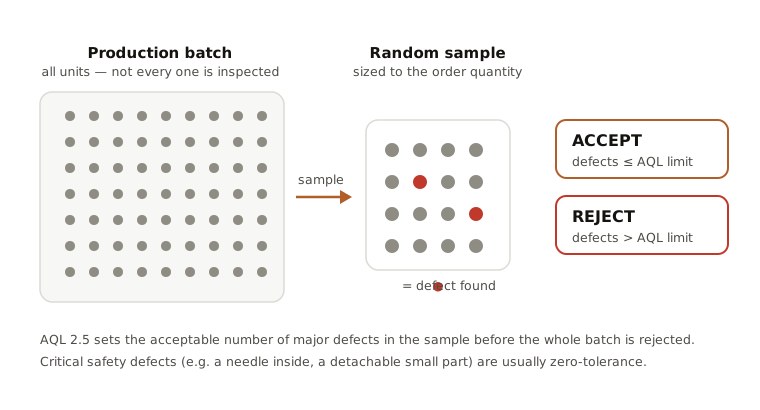
AQL (Acceptable Quality Limit) is a standard sampling method for inspecting a production batch without checking every unit. An inspector pulls a sample sized to the order quantity and an inspection level, then counts defects. “AQL 2.5” is a commonly used limit for major defects — it sets how many defective units in the sample are tolerated before the batch is rejected. For plush, AQL 2.5 batch inspection can be arranged before shipment when required; the exact level and defect criteria are confirmed per project.
What AQL actually is
AQL comes from sampling standards such as ISO 2859-1 (and ANSI/ASQ Z1.4). Instead of inspecting 100% of units, the inspector checks a statistically chosen sample. The AQL number is the threshold: a lower number is stricter. AQL 2.5 is a typical choice for major defects on consumer goods like plush.
Major vs minor defects
- Critical: a safety issue, such as a detachable small part on a young-child toy — usually zero tolerance.
- Major: a defect a customer would likely reject, such as wrong size, an open seam or wrong color — often inspected at AQL 2.5.
- Minor: a small cosmetic issue unlikely to cause a return — often a looser limit such as AQL 4.0.
A common plush set-up is therefore critical = 0 (zero tolerance), major = AQL 2.5, minor = AQL 4.0. The three classes are judged separately in the same inspection, each with its own allowance.
How the sample size is actually chosen
You do not pick the sample size — the standard does. The order (lot) size maps to a sample-size code letter at a chosen inspection level (General Level II is the default), and that code letter gives the number of units to pull and the accept / reject numbers for each AQL. So the sample grows with the order, but far slower than 100%.
| Order (lot) size | Example: 1,201–3,200 pieces. |
|---|---|
| Code letter (Level II) | Maps to code letter K. |
| Sample to inspect | 125 units pulled at random across cartons. |
| AQL 2.5 (major) | Accept on 7 defective, reject on 8. |
| AQL 4.0 (minor) | Accept on 10 defective, reject on 11. |
Those figures are an illustrative read from the ISO 2859-1 / ANSI-ASQ Z1.4 single-sampling tables, not a fixed rule for every order — the binding numbers come from the standard for your exact lot size and level. The takeaway: “AQL 2.5” is not “2.5% defects allowed”, it is a sampling plan with a defined pass/fail count.
What an inspector checks on plush
- Measurements against the approved sample.
- Workmanship: stitching, seams, embroidery and attachment strength.
- Appearance: color, face details and cleanliness.
- Labels, tags and packing against the spec.
How to use AQL on your order
Tell your supplier before production if you expect AQL inspection, name the level for each defect class (critical 0 / major 2.5 / minor 4.0 is common), and agree which defects count as critical, major and minor against your approved sample. The method works only when the acceptance criteria are written down beforehand.
Plush AQL FAQs
Does AQL mean every plush is inspected?
No. AQL is a sampling method: an inspector checks a representative sample sized to the order quantity, not every unit. The result is used to accept or reject the whole batch.
Does AQL 2.5 mean 2.5% defects are allowed?
Not exactly. AQL 2.5 is a sampling plan, not a flat percentage. The order size and inspection level set how many units are pulled and the accept/reject count for that sample; 2.5 is the quality limit those numbers are built around. A lower AQL tolerates fewer defects.
How big is the inspection sample?
It depends on the order size and inspection level, read from the ISO 2859-1 tables — not a fixed percentage. For example, a 1,201–3,200-piece lot at General Level II pulls 125 units, with accept/reject counts set per AQL. Larger orders pull larger samples, but far fewer than 100%.
Can JWC arrange AQL inspection for plush?
AQL 2.5 batch inspection can be arranged before shipment when required. Tell JWC early, and confirm the inspection level and critical/major/minor defect criteria against your approved sample as part of project planning.
Next Resources to Read
Notes & sources
This guide is general quality-inspection education. The AQL definitions summarized here follow sampling standards such as ISO 2859-1 and ANSI/ASQ Z1.4; the binding text is the standard itself. Inspection level, scope and defect criteria are confirmed per project against your approved sample.