Plush Labeling and Warning Requirements
What usually has to appear on a plush label and packaging for US and EU/UK markets.
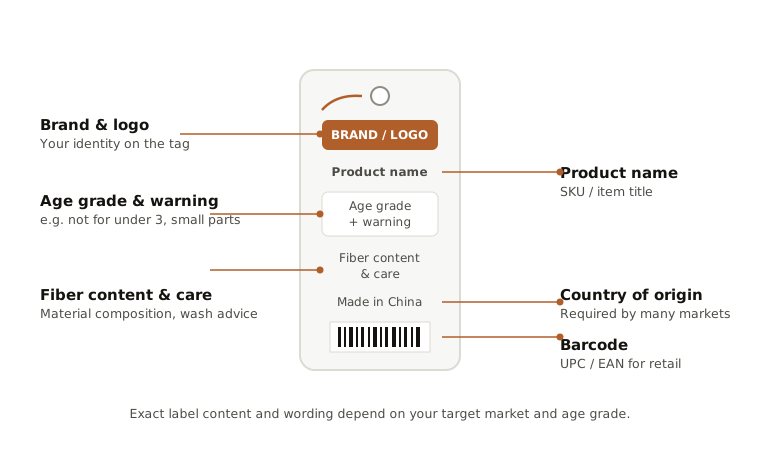
Beyond passing safety tests, a plush usually has to carry the right labels. Common requirements include an age grade and warnings (for example a small-parts warning, or “not suitable for children under 3” with the reason), the market’s conformity mark (CE in the EU, UKCA where required), a US tracking label for children’s products, fiber-content and care information, and country of origin. Exact wording and placement depend on the market and product — confirm with your lab or importer.
Common label elements
| Age grade & warning | Such as a small-parts warning or “not suitable for children under 3 years” with the reason, when the product is not intended for that age. |
|---|---|
| Conformity mark | CE for the EU; UKCA where required for Great Britain; applied when the product meets the rules. |
| Tracking information | US children’s products need a permanent tracking label identifying the batch; the EU requires manufacturer/importer identification. |
| Fiber content & care | Textile labeling rules in many markets require fiber composition and care instructions. |
| Country of origin | For example “Made in China”, required by many destination markets. |
US vs EU/UK: where the rules differ
| US — conformity | No CE-style mark on the toy. Children’s products need a Children’s Product Certificate (CPC) on file (not on the label) backing ASTM F963 testing. |
|---|---|
| US — tracking label | CPSIA requires a permanent tracking label on product and packaging: manufacturer/private-labeller, location and date of production, and batch/run detail. |
| US — choking warning | FHSA cautionary wording (e.g. small-parts choking warning) where applicable, on the package and in online listings and catalogues. |
| EU/UK — conformity | CE mark (EU) or UKCA (Great Britain), at least 5 mm high, applied when the toy meets the rules, backed by a Declaration of Conformity. |
| EU/UK — age warning | The “not suitable for children under 36 months” statement plus the reason, and the round age-warning pictogram per EN71 when the toy is not for under-3s. |
| EU/UK — traceability | Manufacturer and importer name and address on the toy or, if not possible, the packaging; warnings in the language(s) of the country of sale. |
Fibre content, care and origin
Most markets also require textile information: fibre composition (e.g. “100% polyester”) and care/washing guidance under rules such as the US Textile Fiber Products Identification Act and EU Regulation 1007/2011, plus country-of-origin marking like “Made in China”. These usually sit on a sewn-in label and/or the hangtag.
Language is part of compliance
In the EU, safety warnings must appear in the official language(s) of each member state where the toy is sold — so the same product sold across several countries may need multilingual warnings. Plan label space for this early; it changes tag and label artwork.
Why labels are planned, not added last
Labels affect the sample’s look, the tag and packaging design, and the carton marking. Deciding them late forces rework. Plan placement of the woven label, care label, hangtag and warnings during sampling so they fit the design, the packaging and any required languages.
Plush labeling FAQs
What warning does an under-3 plush need?
A plush intended for children under 3 must meet stricter safety rules; one not intended for them often carries a “not suitable for children under 3 years” (or “under 36 months”) warning with the reason, such as small parts, and in the EU the round age-warning pictogram. Confirm the exact wording and symbol for your market with your lab.
What is a CPSIA tracking label?
In the US, children’s products need a permanent tracking label on the product and packaging identifying the manufacturer or private labeller, the location and date of production, and batch/run information, so a specific production run can be traced. It is separate from the Children’s Product Certificate, which is a document kept on file.
Where does the CE mark go on plush?
CE marking is usually applied to the product (often the sewn-in label) and/or packaging, visibly, legibly and at least 5 mm high, when the plush meets EU requirements. The manufacturer applies it via the Declaration of Conformity; confirm placement and size rules with your lab.
Do warnings need to be in local languages?
In the EU, safety warnings generally must be in the official language(s) of the country where the toy is sold, so selling across several markets can mean multilingual labels. Plan label and hangtag space for this. Confirm the required languages per market with your importer or lab.
Do I need a “Made in China” label?
Many destination markets require country-of-origin marking such as “Made in China” on the product or packaging. Confirm your market’s rule with your importer or broker.
Next Resources to Read
Notes & sources
This guide is general education on common plush labeling elements, not legal advice. The requirements summarised here come from frameworks such as US CPSIA, ASTM F963, FHSA cautionary-statement rules and the Textile Fiber Products Identification Act, and EU/UK rules including the Toy Safety Directive 2009/48/EC, EN71, CE/UKCA marking and EU Regulation 1007/2011 on textile labelling — the binding text is the regulation itself, and content, wording, symbols, sizes and placement differ by market and age grade and change over time. Confirm requirements with your testing laboratory, importer or an official source for each destination market.