How Custom Plush Toys Are Made: The Production Process
A plain walk through how a custom plush is actually built, so you know what each stage controls.
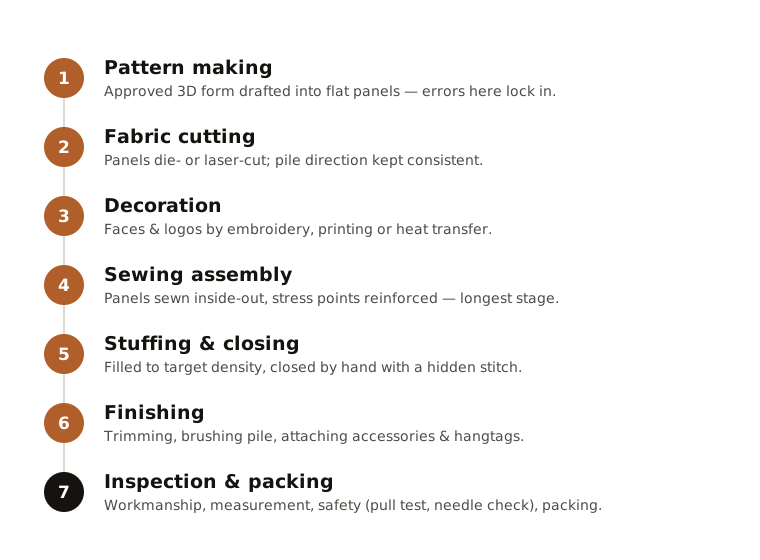
Custom plush is made in a defined sequence: pattern making from the approved design, fabric cutting, surface decoration (embroidery, printing or heat transfer), sewing the panels into a shell, stuffing and closing, finishing and accessory assembly, then inspection and packing. Each stage controls a specific quality attribute — cutting sets dimensions, sewing sets strength and shape, stuffing sets firmness — which is why the tech pack and golden sample matter at every step. Timing varies by project.
The main production stages
- Pattern making: the approved 3D form is drafted into flat panels with seam allowance and symmetry — errors here lock into every unit.
- Fabric cutting: panels are die- or laser-cut; pile direction must stay consistent or the nap looks wrong.
- Decoration: faces, logos and graphics are added by embroidery, printing or heat transfer before assembly.
- Sewing: panels are sewn inside-out, with reinforcement at stress points (neck, limbs, tail); usually the longest stage.
- Stuffing & closing: the shell is turned, filled to target density, and closed by hand with a hidden ladder stitch.
- Finishing: trimming, brushing out the pile, attaching accessories and hangtags.
- Inspection & packing: workmanship, measurement, safety and packing checks before the order is packed.
Decoration methods at a glance
| Embroidery | Stitched thread; durable and textured; best for faces, logos and small detail. |
|---|---|
| Screen / digital printing | Ink on fabric; suits larger graphics and gradients; needs colour and wash-durability checks. |
| Heat transfer | A printed film pressed onto fabric; sharp detail and gradients, useful where embroidery is hard; check adhesion and wash. |
| Composite / bonded fabric | Laminated or backed fabrics used for stiffer parts or special finishes; confirm hand-feel and safety. |
Why each stage needs a reference
Because quality compounds, a small cutting error or an inconsistent stuffing density shows up across the whole batch. The approved tech pack and the signed golden sample give every department — cutting, embroidery, sewing, stuffing, QC — one standard to work and check against, which is what keeps bulk matching the sample.
Where QC fits
Inspection is not only at the end. Incoming materials, in-line sewing and stuffing, and the final packed goods can each be checked. Plush-specific checks include attachment (pull) tests on eyes and accessories, seam-strength checks, stuffing density, and a needle / metal-detection check to confirm no broken needle or foreign object remains inside the filling — a basic safety step for soft toys.
Plush production FAQs
How long does plush production take?
It varies with design, quantity, decoration and season, and Chinese New Year reshapes the calendar. Rather than assume a fixed figure, plan backward from your in-store date with buffer; the lead-time guide shows how the stages add up.
What is the longest stage?
Sewing assembly is usually the longest single stage, because panels are joined and features attached by skilled operators. Accurate cutting and clear construction notes upstream keep sewing efficient.
Do factories check for needles in plush?
A needle / metal-detection check is a standard soft-toy safety step to confirm no broken needle or metal fragment remains inside the filling. Confirm it is part of your QC and inspection scope, especially for children’s toys.
Next Resources to Read
Notes & sources
This guide is general manufacturing education. Stage order and methods vary by factory and product; it does not promise specific timelines or capabilities. Production route, decoration methods and QC scope are confirmed per project.